Reunited animals · 6 November 2026
A cat vanished in Yellowstone. Sixty days later, a microchip spoke for him
The tempting version says he walked all the way home. The useful version is less tidy: a frightened cat, a stranger who paid attention, and an identity that survived the journey.
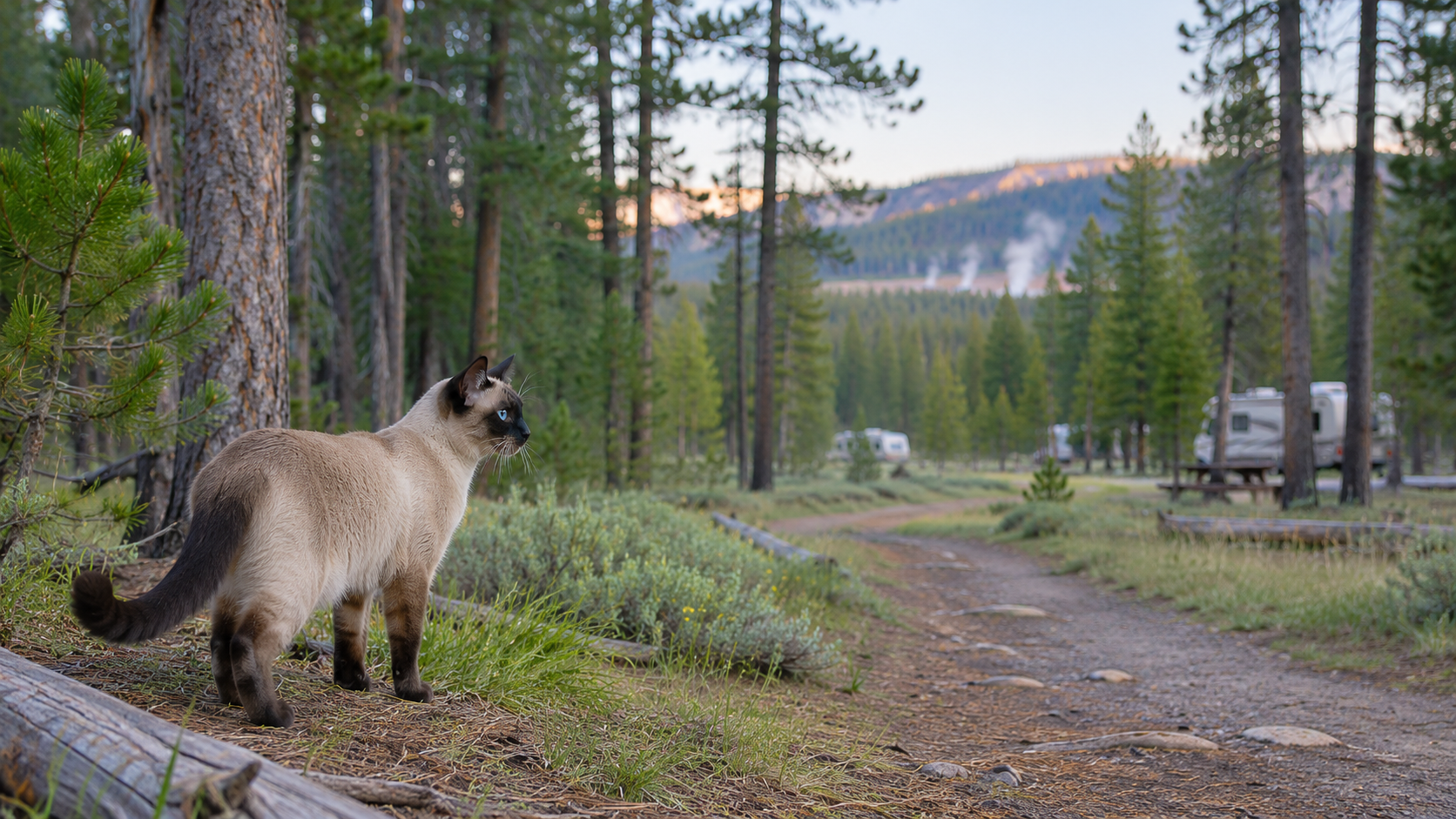
Rayne Beau's story is often compressed into a perfect headline: cat walks 900 miles home. It is memorable, but it goes further than the evidence. We know where he disappeared and where he was found. We know the condition he was in. We do not know every road, field or vehicle between those two points. That gap matters, because a true lost-pet story does not need an invented certainty to be extraordinary.
On 4 June 2024, Benny and Susanne Anguiano reached Fishing Bridge RV Park in Yellowstone National Park with their two cats. It was the animals' first forest trip. Soon after arrival, Rayne Beau was startled and ran into the trees. The couple searched for four days. They called, left out familiar treats and toys, and covered the area they could reach. On 8 June they had to drive back to Salinas, California, without him.
Leaving an animal behind is the moment many search guides fail to describe. It does not mean the family has stopped caring. Often it means work, distance, park rules and the limits of a human body have won for the day. The Anguianos went home with no reliable sighting and no route to follow. Weeks passed. There was no GPS trail and no sequence of confirmed reports joining Wyoming to California.
In August, a woman in Roseville noticed an underweight cat on the street. She offered food and water and kept watching rather than forcing a quick approach. On 3 August she managed to contain him and took him to the local SPCA. Staff scanned him. The microchip company then contacted the Anguianos with news that sounded almost implausible: Rayne Beau was alive, in California, hundreds of miles from Yellowstone and roughly 200 miles from home.
The family collected him the following day. He had lost six pounds, around forty per cent of his body weight. His paws were badly worn and his protein level was low. Those details suggest a long period without dependable care. They do not prove that he covered the entire distance on foot. He may have walked much of it; he may have crossed part of the route in a vehicle. The responsible answer remains: we do not know.
What we do know is more useful to another family. Identification did not depend on a collar still being attached after two months outdoors. The chip carried a number, the registry connected that number to current contact details, and the shelter used the system. Yet the technology was only the last link. A person first had to notice the cat, return with food, earn enough trust to contain him and take him somewhere with a scanner.
After the reunion, the Anguianos added tracking devices: AirTags for two cats and a GPS tracker for Rayne Beau. That is a sensible extra layer, not a replacement for permanent identification. Trackers can lose charge, connection or their attachment. A registered microchip cannot show a live location, but it can restore a name when an animal reaches a vet, shelter or rescue group.
LollyMap studies reunions because every case reveals a point where a search can improve. Rayne Beau's route may remain unknown. The rescue chain is clear: persistent owners, an observant stranger, a safe handover, a scanner and correct registry information. None of those steps is cinematic. Together they brought a living animal back to his family.
Case sources
- Associated Press — A lost cat's mysterious 2-month, 900-mile journey home to California
- KQED — A Lost Cat's Mysterious 2-Month, 900-Mile Journey Home to California
Original LollyMap article based on the sources listed above. Distances are approximate and the cat's complete route has never been established.