Reunited animals · 9 November 2026
Everyone knew the local stray. Nobody knew she had been missing for six years
Feeding kept her alive, but recognition brought her to safety. Rose's case shows why a familiar stray should still be reported, scanned and assessed.
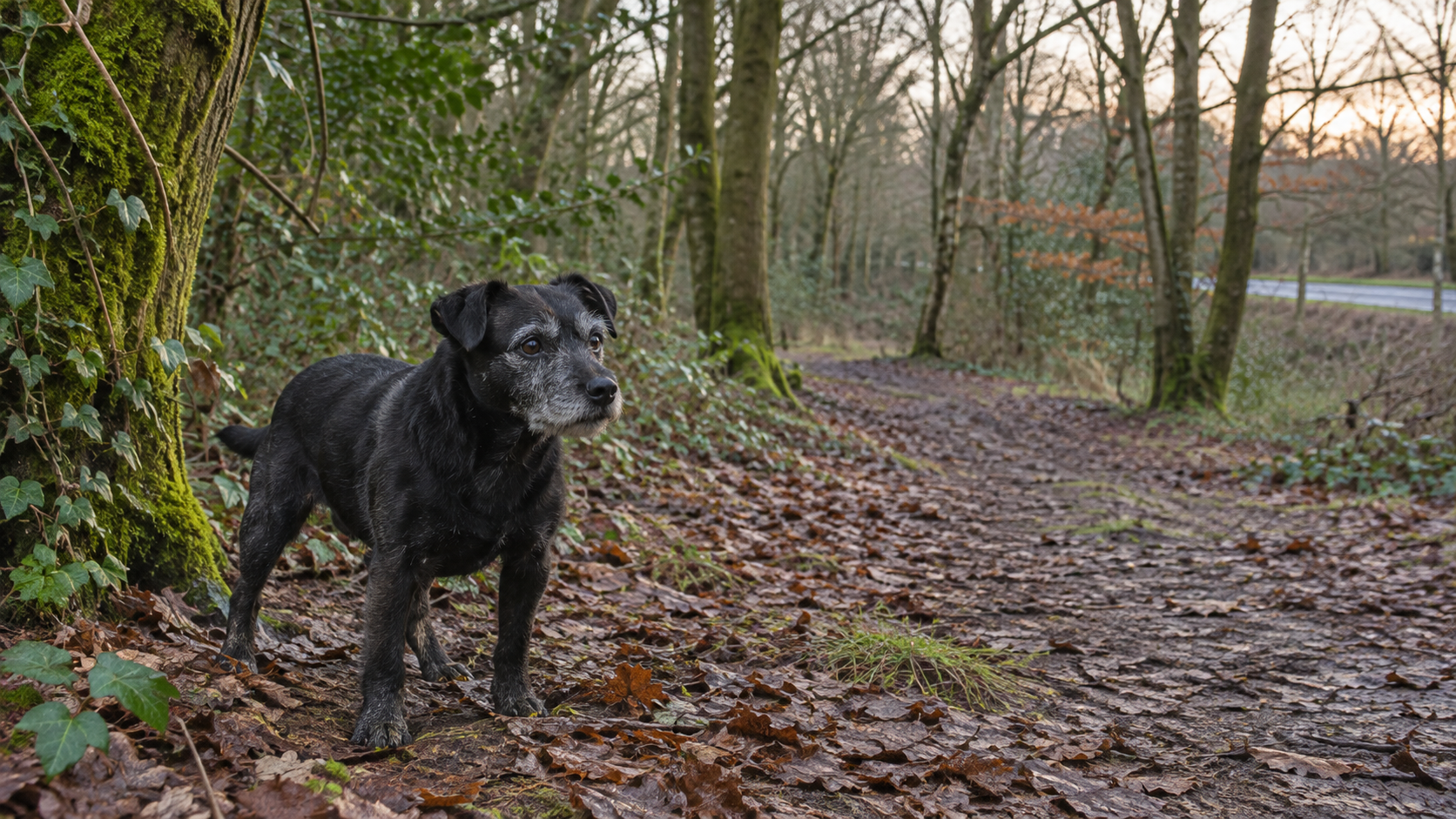
By late 2023, people around Crawley Down knew there was a small black dog living near the woods. Some residents fed her, and reports said she also ate food left for badgers. A long-term stray can become part of the scenery: seen often enough to seem settled, but never closely enough to reveal an identity. Rose was not simply a local feral dog. She was a twelve-year-old Patterdale terrier reported missing more than six years earlier.
Rose had disappeared from Ashurst Wood in March 2017, within twenty-four hours of being adopted. Her new family distributed leaflets and appealed online, but the trail went cold. She was eventually found about six miles away. Rescuers were careful not to claim a complete route or date of arrival in Crawley Down. The unused railway line has been suggested as a possible path, yet the years between the disappearance and the final sighting remain largely undocumented.
The event that changed the outcome was ordinary. At the end of November, a passer-by saw a little black dog near Wallage Lane and watched her dart into bushes. Instead of accepting her as another unowned animal, the witness contacted Lost Dog Recovery UK South. Volunteers then spoke with local residents and learned that the dog had survived in the area for years. The first rescue tool was not a cage or camera; it was a person treating a familiar sight as unresolved.
Regular feeding had helped Rose survive, but it had not made her safe. She still crossed near a road, searched for water and faced cold winters as she aged. This is why a long-established stray should be reported even when it appears capable. Reporting does not require rushing toward the animal or removing food overnight. It opens a route to coordinated observation, a microchip scan and welfare decisions that casual feeding alone cannot provide.
The team placed remote cameras and established when Rose visited the feeding area. They watched her routine for several days rather than filling the woods with people. On 9 December, volunteers set a humane trap with warm chicken. Camera alerts showed Rose approaching and withdrawing between roughly 5 p.m. and 7 p.m. She eventually entered, the door closed and the volunteers moved her to secure kennels and veterinary care.
That patient sequence matters. A dog living independently for years may avoid eye contact, voices and human movement even if she once lived in a home. Chasing can push her toward traffic or out of a known area. A monitored trap turns a predictable visit into a controlled recovery without a physical struggle. It must be correctly sized, checked frequently and used by people able to respond immediately once the animal enters.
A microchip revealed Rose's history. She had been missing since 2017 and was now a senior dog with a greying muzzle. Finding the original family still required further work, illustrating a limit of identification systems: numbers remain in the body, while phone numbers and addresses change. Current registry details shorten the route. Even when details are old, the chip can provide a stable starting point that no collar could preserve through six winters.
There was no conventional reunion. The family had moved and its circumstances had changed; it could no longer take Rose back. Reports said the family was delighted that she was alive and safe, while sad about the outcome. It is easy to turn that decision into a harsh headline. Welfare requires a quieter question: who can meet the needs of an elderly dog that has spent half her life avoiding people and now requires rehabilitation before another home?
Rose was transferred toward rescue care and eventual rehoming rather than pushed into an unsuitable return. She was described as shocked and frightened but gentle, and in good condition considering her history. A responsible assessment needed to cover health, stress, response to indoor space and escape risk. Safety on capture day was only the first stage. The next stage was teaching her that warmth, routine and human proximity could remain predictable.
The case also begins with a prevention lesson. Newly adopted dogs are at particular risk because they do not yet recognise a property as home or a person as their secure point. For the first days and weeks, doors, gardens and vehicle transfers need double protection. A properly fitted escape-resistant harness, a backup connection and controlled thresholds matter more than confidence that a frightened dog will answer her new name.
LollyMap treats Rose's recovery as a correction to two assumptions. Survival does not mean welfare, and being found does not always mean returning to the previous household. The volunteers succeeded because they observed before acting, used identification without overpromising and planned for the dog in front of them. A lost-animal expert must protect the present animal, not chase the most emotionally satisfying version of the past.
Case sources
- ITV News — Missing black terrier found in Sussex woods after six years
- UPI — Lost dog found after 6 1/2 years living on her own in the woods
- Crawley Borough Council — Lost and found dogs
Original LollyMap article based on the sources listed. The date Rose settled in Crawley Down and the full course of her missing years are unknown.