Lost and found animal stories · 11 November 2026
The camera proved Valerie was alive. The rescue plan brought her home
For roughly 450 days the reports were stories without proof. One usable image changed the search from island-wide hope into a patient recovery operation.
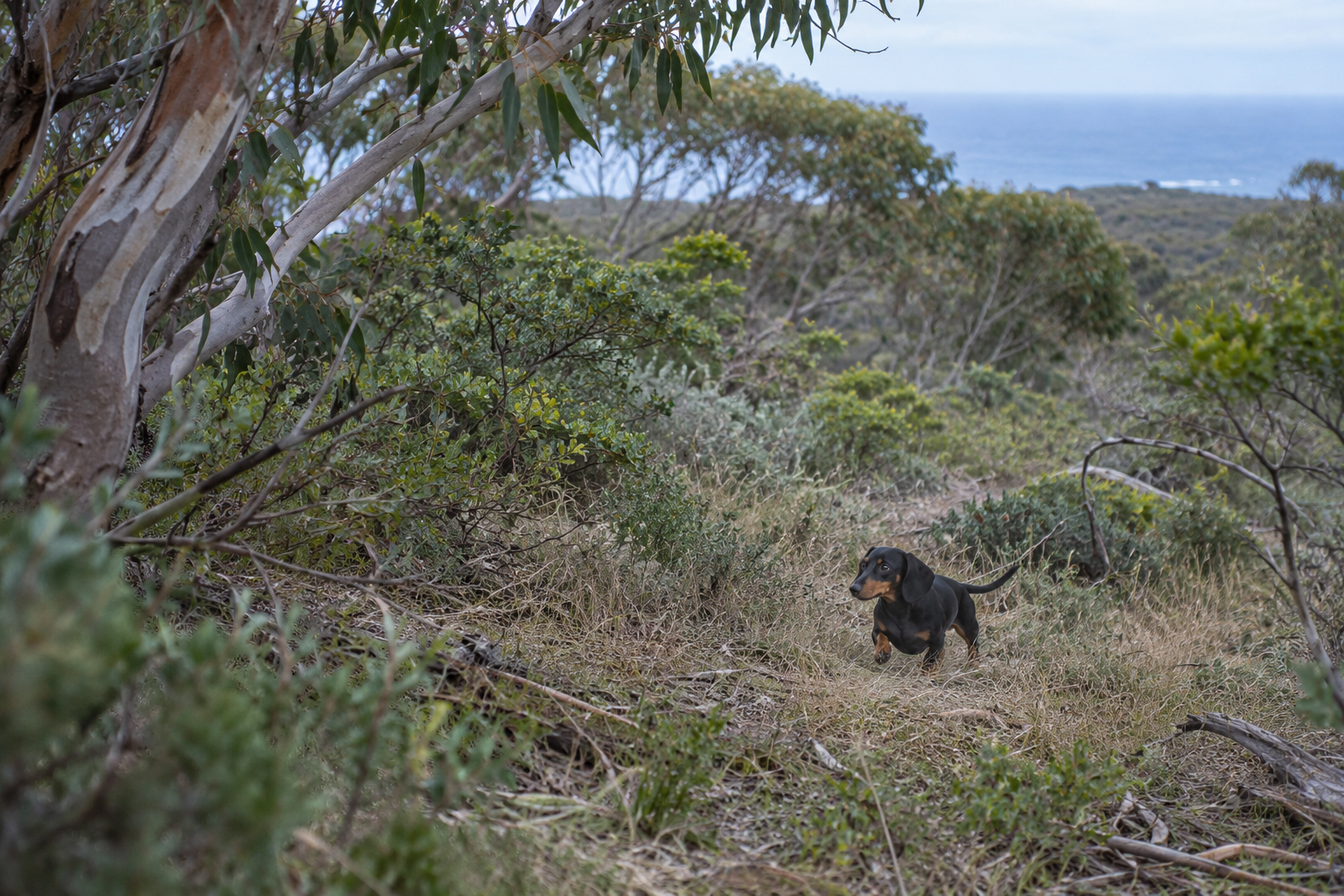
A reported sighting can keep a search alive, but it cannot by itself tell a rescue team where to place a camera at dawn. That was the central problem in Valerie's disappearance. For about 450 days, people on Kangaroo Island spoke of seeing a small dachshund in the South Australian bush, yet there was little proof that could support an operation. Then a photograph showed a tiny figure running across an open field. Her shape and moving ears were enough to turn a long-running story into a location that could be watched, tested and understood.
Valerie had vanished on 13 November 2023, the day Georgia Gardner and Josh Fishlock arrived at Stokes Bay for a camping holiday. ABC Australia's later reconstruction says the couple took their one-year-old miniature dachshund to the beach, then left her in a playpen with a bed, toys and a snuffle mat while they went fishing about 200 metres away on rocky ground. She escaped. They searched, but eventually had to return to mainland Australia without her. The decision haunted the case; the physical search could not simply continue everywhere on a large island.
Once the photograph gave the search a focus, Lisa and Jared Karran of Kangala Wildlife Rescue began building evidence rather than chasing the dog. Field cameras recorded Valerie visiting a proposed trap area. Her owners, who had kept her belongings even after moving from Broken Hill to Albury, sent familiar items and a worn shirt carrying Georgia's scent. The team placed soft bedding and toys inside. Night after night they watched a wary dog step in, take an interest and leave again. Familiarity had to accumulate without sudden pressure.
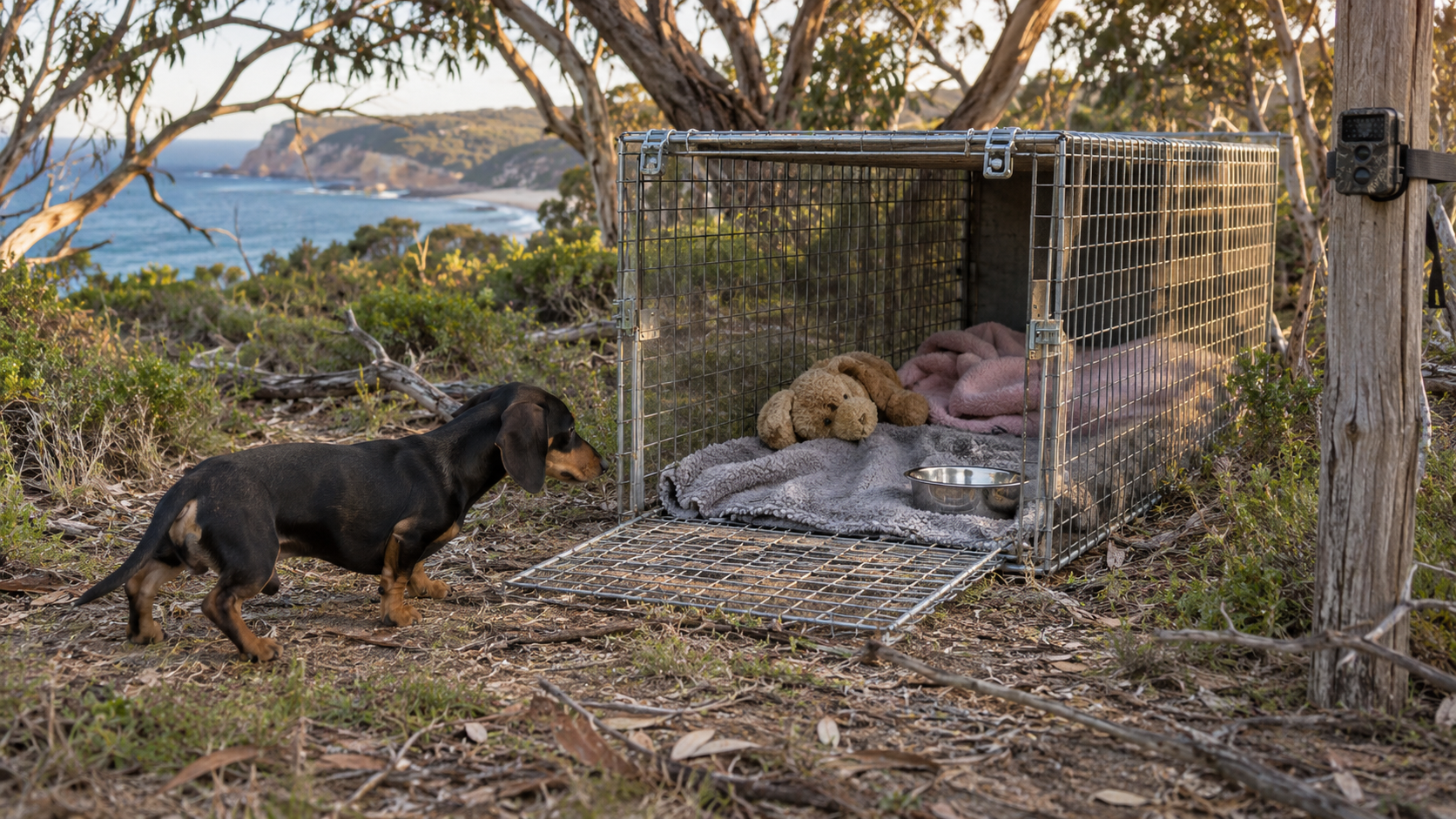
The trap itself had to account for more than Valerie. Wildlife moved through the same landscape, so an automatic plate could close on the wrong animal. Jared built a remote door using an electric car-window motor. Cameras let the team see the occupant before anyone activated it. After another night of waiting, the rescuers stood down at around 8:30 on the morning of 25 April but kept the live feed available. At about 12:30 Valerie appeared in daylight. Jared pressed the control, the door closed, and 529 days in the bush ended without a pursuit.
Associated Press estimated that volunteers had spent about 1,000 hours searching and covered roughly 5,000 kilometres. Those figures are useful because they show the scale of organised work, not because distance alone produced the result. The decisive progress came when sightings were narrowed, camera patterns were established and a safe capture point became predictable. Lost-pet searches often gather activity faster than knowledge. A shared map, consistent times and original images are more valuable than dozens of uncoordinated people walking through the same area.
Valerie was found in remarkably good condition and weighed 6.8 kilograms, compared with about four kilograms when she disappeared, according to AP. That does not prove how she lived. Later reporting recorded competing views about whether anybody fed her. The Karrans, who had watched her alone and wary of people over several weeks, did not believe she relied on a household. Small animals, roadkill and other food were suggested, but no one observed 529 days of meals. A responsible account labels this as speculation instead of turning survival into a tidy bushcraft story.
The distinction matters. A dog surviving an extreme absence does not make the environment safe, and Valerie's condition cannot predict another dog's chances. Cold, traffic, snakes, raptors, dehydration and injury remained real risks. Calling the period an adventure can make the outcome feel inevitable when it depended partly on luck. The repeatable part begins later: verify the animal, reduce disturbance, watch behaviour, create a routine and use a capture method that is supervised by people who understand both dogs and local wildlife.
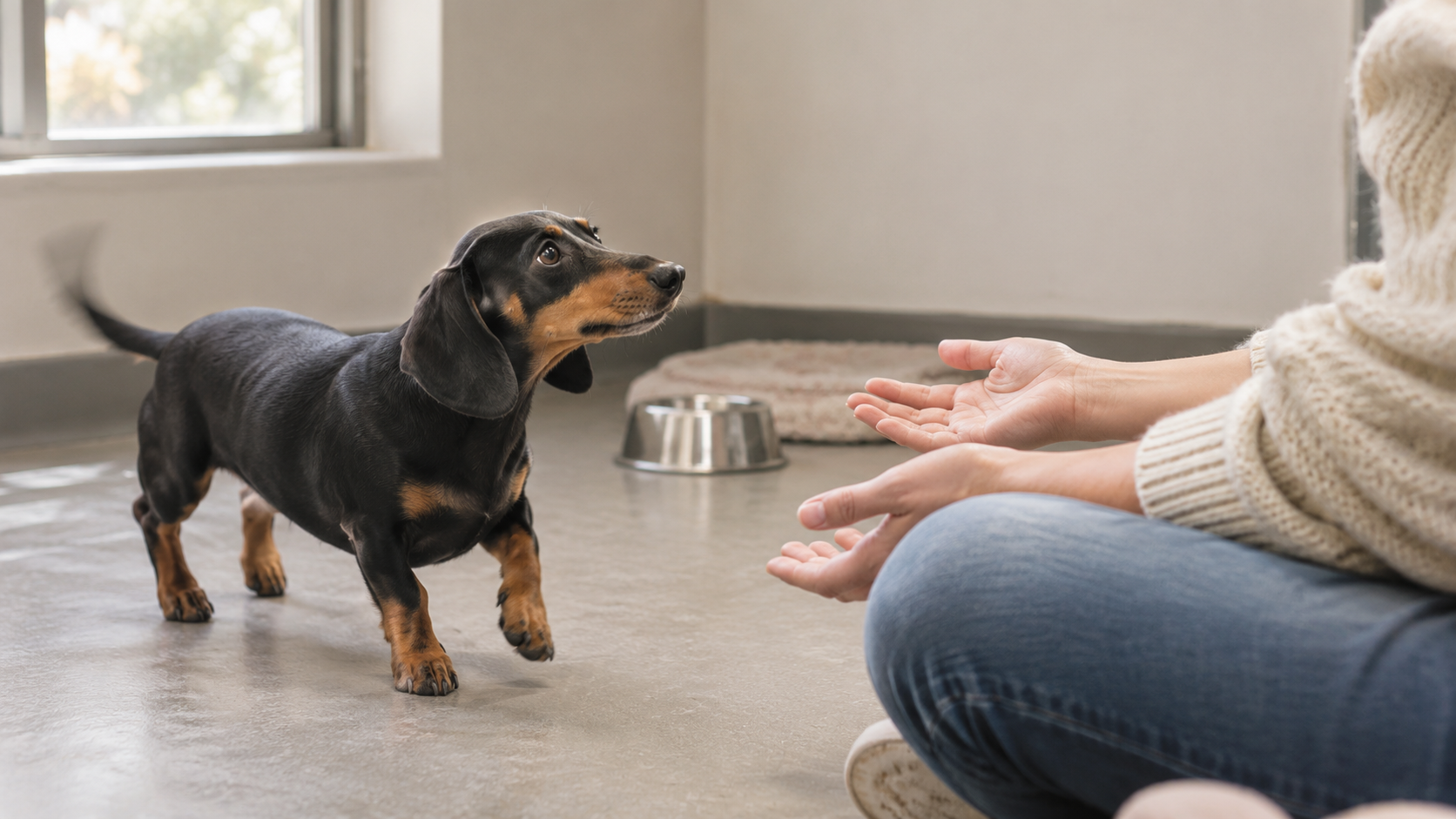
Valerie met Georgia and Josh again on 6 May, 540 days after the separation. Georgia sat on the floor while the dog was brought into the room. The published accounts describe Valerie approaching quickly, wagging and making the familiar sounds her owner remembered. Even so, the handover was not treated as a test of memory. Valerie had spent eleven days with the rescue team, and her owners were working with a dog behaviourist on the transition home. Their plan included a secure space where she could decompress rather than being surrounded by demands.
That approach is relevant when any dog has been loose for a prolonged period. Calling, running forward or surrounding it may feel loving to a person and threatening to the animal. A search coordinator should ask the public to report rather than chase. Food stations should be deliberate so that the dog does not drift between competing locations. Cameras must be checked, and a humane trap must never be left as an unsupervised shortcut. It needs the right size, weather protection, frequent monitoring and a plan for non-target wildlife.
Prevention at a campsite needs the same layered thinking. A portable pen is not a guaranteed barrier on unfamiliar ground. Check its height, joins, base and stability, then add a lead or secure line where appropriate. Keep identification and microchip details current, carry recent photographs, and attach a visible tag. Most importantly, consider how the dog reacts when left alone. Valerie's owners later said separation anxiety played a role. A short physical distance can still feel enormous to an anxious animal in a place with new sounds and smells.
Back in Albury, Valerie was due to rejoin cat Lucy and cattle dog Mason and meet the family's newer dachshund, Dorothy. Those introductions required the ordinary patience that follows an extraordinary rescue. LollyMap's practical lesson lies in the change from searching everywhere to learning one dog's pattern. The photograph did not rescue Valerie. It made a hypothesis testable. Cameras, scent, bedding, repeated visits and the remote door then reduced uncertainty step by step. In difficult recoveries, patience is not waiting for luck. It is the deliberate work of making the safest next movement belong to the animal.
Case sources
- ABC Australia — Inside the mission to rescue dachshund Valerie
- ABC Australia — Valerie reunited with owners after Kangaroo Island rescue
- Associated Press — Miniature dachshund reunited after 18 months on an Australian island
Original LollyMap reporting based on the sources listed. Valerie's exact movements and food sources during the 529 days were not documented; proposed explanations remain hypotheses.